
If you’re new to SEO, you may feel overwhelmed by the technical terms, constant updates, and the way Google keeps changing the rules. But don’t worry — SEO is not as complicated as it looks. Once you understand the basics of how search engines work, you’ll see that SEO is really about one thing:
👉 Helping people find the right information at the right time.
This beginner-friendly SEO guide will walk you through how search engines work in 2026, what SEO actually means, and how you can use it to get more visibility, more traffic, and more customers online — even if you’re just getting started.
Let’s dive in.
What Is SEO in Simple Words?
SEO (Search Engine Optimization) is the process of improving your website so that search engines like Google show it to more people.
When someone searches:
- “best hotels near me”
- “digital marketing freelancer in Hyderabad”
- “how to fix a slow laptop”
Google’s job is to show the most helpful, most trustworthy, and most relevant results.
SEO helps your website become one of those results.
In simple words:
👉 SEO = Making your website Google-friendly so people can find it easily.
How Search Engines Work in 2026 (Simple Breakdown)
How Search Engines Work in 2026 like Google use artificial intelligence more than ever before. Instead of relying only on keywords, Google now focuses on:
✔ user intent
✔ content quality
✔ website experience
✔ trust signals
✔ real-world data
✔ user interactions
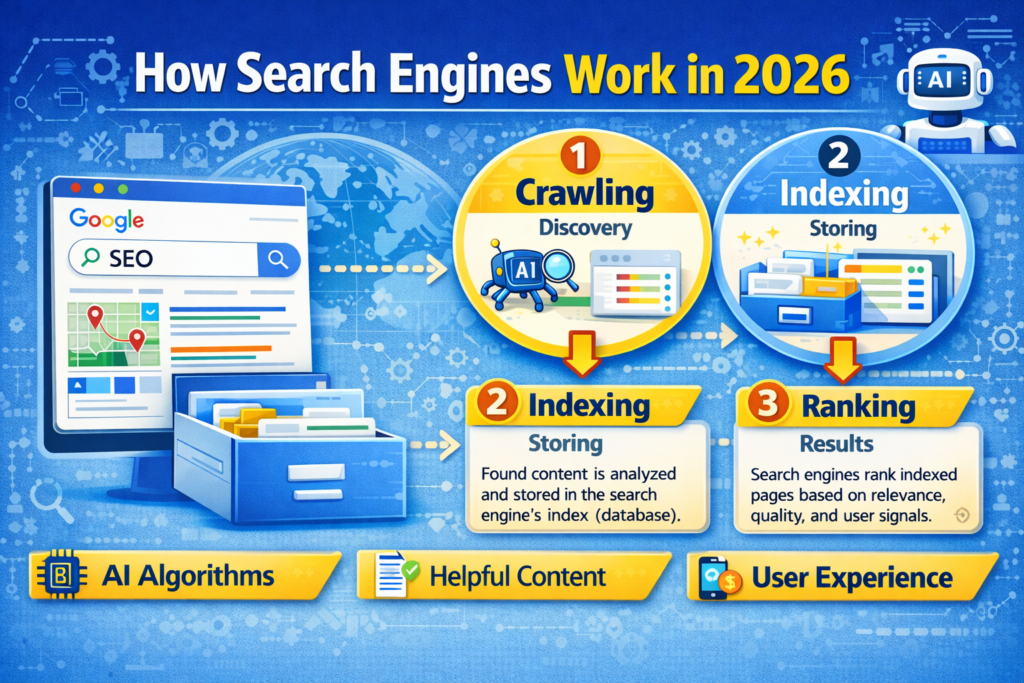
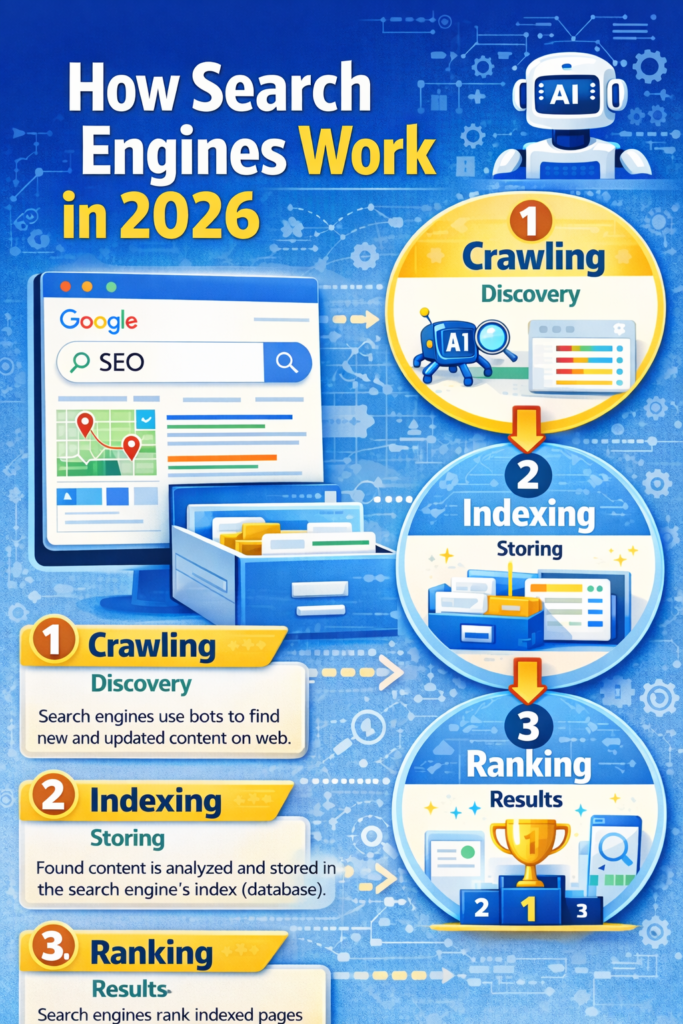
To help you understand better, search engines work in three main stages:
How Search Engines Work in 2026
1. Crawling – Discovering Your Website
Search engines use bots (called crawlers or spiders) to scan the internet.
These bots:
- visit your website
- read your pages
- follow links
- understand your structure
Think of crawlers like tiny robots exploring your website room by room.
If your pages are hard to access or hidden, Google might not find them. That’s why having:
- proper sitemaps
- clean navigation
- working links
…is very important.
2. Indexing – Storing Your Website
After scanning your content, Google stores it in its massive database called the index.
This is where Google keeps everything it has discovered.
If your page is not indexed:
❌ it will NEVER appear on Google search.
Common reasons why pages aren’t indexed in 2026:
- Duplicate content
- Thin or low-quality content
- Slow-loading pages
- Blocked by robots.txt
- No internal links
- No value for users
A good rule to remember:
👉 If Google doesn’t think users will benefit from your page, it won’t index it.
3. Ranking – Showing the Best Results
Once your page is indexed, Google decides where to place it in search results.
This is called ranking.
Google uses more than 200+ ranking factors, and in 2026, many of these are powered by AI, including Google’s MUM and Gemini models.
The goal is simple:
👉 Provide the most helpful answer for the searcher.
Google analyzes:
- How relevant your content is
- How helpful and complete it is
- Whether users trust your website
- How fast and mobile-friendly your pages are
- How people interact with your page
- How many trustworthy websites link to you
The more value you provide, the higher you can rank.
How Search Engines Work in complete beginner guide
What Has Changed in 2026? (SEO Update)
SEO today is not the same as it was 5 or 10 years ago. Google has become smarter, more human-like, and deeply focused on user experience.
Here are the major changes:
1. AI-First Search Algorithms
Google now uses AI models like:
- Gemini
- MUM (Multitask Unified Model)
- BERT
These models can:
- understand natural language
- connect multiple topics
- read images and videos
- detect patterns of good vs bad content
This means keyword stuffing no longer works.
Google wants meaning, not just words.
2. Helpful Content System
Google prioritizes helpful, original, and people-first content
…won’t rank.
Content that is:
✔ detailed
✔ informative
✔ written by someone with real experience
✔ updated
✔ engaging
…ranks much higher.
3. User Experience Matters More
UX (User Experience) is a ranking factor.
Google evaluates:
- Website speed
- Mobile responsiveness
- Page layout
- Navigation
- Ads and pop-ups
- Time on page
- Bounce rate
If users leave your page quickly, Google thinks it wasn’t helpful.
4. Search is More Personalized
Google now tailors results based on:
- location
- search history
- device
- preferences
- behavior
- brand familiarity
This means focusing on local SEO, brand-building, and consistent content is now more important than eve
How Search Engines Work in the way search engines understand content has become far more advanced than before. Instead of simply matching keywords, Google now focuses heavily on context, user behavior, and real intent. This means that creating helpful, people-first content matters more than relying on technical tricks. If your content genuinely answers what users are searching for, Google is more likely to push your page higher in the results.
search engine work Another major shift is the increasing use of AI-powered search, including Google’s Search Generative Experience (SGE). When users ask a question, AI provides a summarized answer at the top of the results. For beginners, this might seem like SEO is becoming harder, but the truth is: quality, clarity, and authority matter more than ever. If your content is structured clearly—with headings, bullet points, and genuine value—you still have a strong chance of ranking.
In addition, search engines in 2026 measure how users interact with your site. If visitors stay longer, read your content, and click through to other pages, Google interprets that as a sign of trust and usefulness. This is why SEO is no longer about ranking pages—it’s about building an excellent user experience. When you combine helpful content with fast loading speed, mobile-friendly design, and clear navigation, your website naturally climbs the rankings.
The 3 Main Pillars of SEO (2026 Edition)
To succeed in SEO today, you only need to understand three pillars:
- How to search engine work On-Page — What You Control on Your Website
This includes:
- Titles and meta descriptions
- Headings
- Keywords (natural use)
- Internal linking
- Image alt text
- URL structure
- Quality of your content
Your content MUST match the searcher’s intent.
If someone searches “how to bake a chocolate cake,” they want a recipe — not a story about your childhood.
2. How to search engine work Off-Page — Signals That Come from Outside
This mainly refers to backlinks — links from other websites pointing to your site.
Backlinks act like votes of confidence.
Other off-page signals include:
- Social media engagement
- Brand mentions
- Google reviews
- News features
- Citations
The more trust your brand builds online, the better you rank.
3. how to search engine work Technical — How Well Your Website Works
Technical SEO makes it easy for search engines to crawl, index, and understand your site.
Includes:
- Fast loading speed
- Mobile optimization
- XML sitemaps
- Indexing management
- HTTPS security
- Clean coding
- Structured data (schema)
- Fixing broken links
Even perfect content won’t rank if your technical foundation is weak.
Learn how to search engines work in 2026 with this beginner-friendly SEO guide. Simple tips, ranking basics, and updated strategies to grow your website visibility./seo-services
How Search Engines Work in 2026 Matters
Here’s why SEO is still the most powerful digital marketing strategy:
✔ How to search engine work brings free traffic
You don’t pay for every click like Google Ads.
✔ How to search engine work builds trust & authority
People trust Google’s top results.
✔ How to search engine work gives long-term results
A single well-ranked article can bring traffic for years.
✔How to search engine work helps small businesses compete with big brands
Local SEO levels the playing field.
✔ How to search engine work increases sales, leads, and visibility
More visibility → more customers.
SEO is not just marketing.
SEO is growth.
Google Search Central – SEO Starter Guidehttps://developers.google.com/search/docs/fundamentals/seo-starter-guide
✅ Google Search Central – How Google Search works
✅ SEO best practices
✅ How to make your website more visible
✅ Indexing, crawling, and ranking basics
✅ Technical SEO fundamentals
Simple Tips for Beginners to Start How to SEO in 2026
Here’s what you can do even if you’re just starting:
✔ Use simple, easy keywords
Focus on long-tail keywords like:
“best photographer in Coimbatore for weddings”
✔ Create helpful content
Write like you’re explaining to a friend.
✔ Optimize your website basics
Title, meta description, headings, images.
✔ Add internal links
Link your pages to each other.
✔ Keep improving your content
Google loves fresh updates.
✔ Build online trust
Get reviews, social proof, and local mentions.